
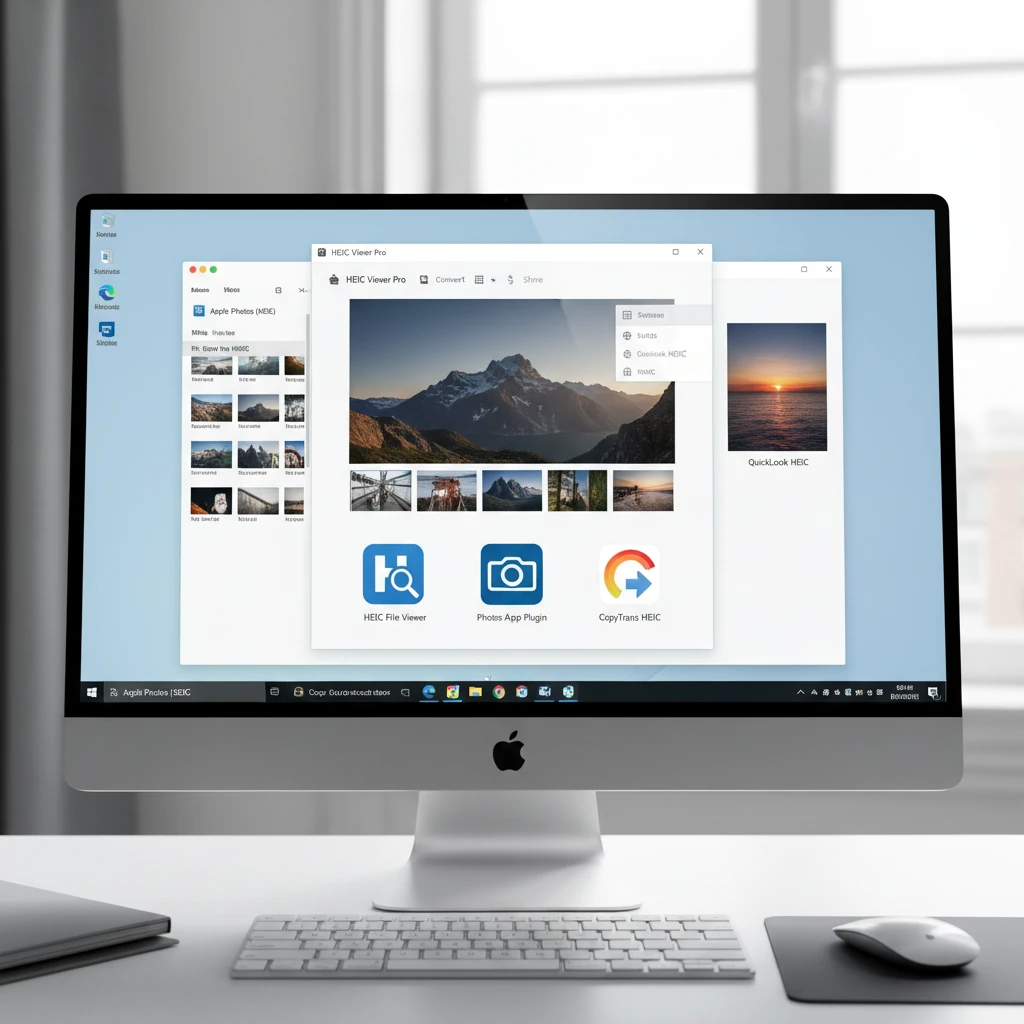
You’ve probably been there: someone with an iPhone sends you a photo, but when you try to open it on your Windows computer, you’re met with an error message or a generic file icon. Welcome to the world of HEIC files – Apple’s modern image format that’s become the default for iOS photos since 2017.
HEIC (High Efficiency Image Container) creates smaller file sizes while maintaining excellent image quality, but Windows doesn’t support it natively in most configurations. This leaves millions of Windows users frustrated when they can’t view photos from their iPhone-wielding friends and family.
The good news? You have several effective options to view HEIC files on Windows, from built-in solutions to specialized viewers and online converters. Let’s explore the best approaches to solve this compatibility puzzle once and for all.
TL;DR: Quick Solutions for HEIC Files on Windows
- Fastest fix: Install HEIF Image Extensions from Microsoft Store (Windows 10 version 1809+ and Windows 11)
- Most versatile: Use a third-party image viewer app that supports HEIC natively
- No installation needed: Convert HEIC files to JPEG using online converter tools
- Bulk processing: Desktop converter applications for handling multiple files at once
- Universal solution: Ask iPhone users to change their camera settings to capture in JPEG format
Understanding HEIC: Why Windows Struggles with Apple’s Image Format
HEIC stands for High Efficiency Image Container, and it’s part of the HEIF (High Efficiency Image Format) standard developed by the Moving Picture Experts Group. Apple adopted this format because it offers roughly 50% smaller file sizes compared to JPEG while maintaining similar or better image quality.
However, there’s a licensing issue at play. The HEIF codec requires patent licensing fees, which Microsoft doesn’t include by default in Windows installations. This creates the compatibility gap that frustrates users when they encounter HEIC files.
Common Misconceptions About HEIC Support
Many users believe Windows simply «doesn’t support» HEIC files, but that’s not entirely accurate. Windows 10 (build 1809 and later) and Windows 11 can support HEIC files – you just need to install the proper codec. The confusion arises because this codec isn’t pre-installed due to licensing considerations.
Another misconception is that HEIC files are somehow «locked» to Apple devices. In reality, HEIC is an open standard that any device or software can implement with proper licensing.
Best HEIC Viewer Options: Detailed Comparison
| Solution Type | Setup Required | Best For | Cost |
|---|---|---|---|
| Microsoft HEIF Extensions | One-time install | Native Windows integration | Free (with codec purchase) |
| Third-party viewers | App installation | Advanced features, batch viewing | Free to premium |
| Online converters | None | Occasional use, privacy-conscious users | Usually free |
| Desktop converters | Software installation | Bulk conversion, offline use | Free to premium |
Method 1: Using Microsoft’s Official HEIF Extensions
The most seamless solution involves installing Microsoft’s official HEIF Image Extensions, which adds native HEIC support to Windows File Explorer, Photos app, and other built-in image viewers.
Step-by-Step Installation Process
- Open the Microsoft Store on your Windows computer
- Search for «HEIF Image Extensions» or «HEVC Video Extensions»
- Install the HEIF Image Extensions (free) and HEVC Video Extensions (typically $0.99)
- Restart your computer to ensure proper codec registration
- Test by double-clicking a HEIC file – it should now open in the Photos app
Key insight: You might need both extensions because some HEIC files contain HEVC-encoded data, especially Live Photos from iPhones. Installing only the HEIF extension may result in some files still not opening properly.
Troubleshooting Microsoft Extensions
If HEIC files still won’t open after installation, check your Windows version. You need Windows 10 build 1809 (October 2018 Update) or later. To verify your build number, press Windows + R, type «winver,» and press Enter.
Some users report that clearing the Windows thumbnail cache helps after codec installation. You can do this by running «cleanmgr» from the Start menu and selecting «Thumbnails» for cleanup.
Method 2: Third-Party HEIC Viewer Applications
If Microsoft’s extensions don’t work for your situation or you want additional features, third-party image viewer applications offer robust alternatives. These applications typically provide faster loading times, batch processing capabilities, and support for a wider range of image formats.
What to Look for in a HEIC Viewer
When evaluating image viewer applications, prioritize these features:
- Native HEIC support without requiring separate codec installations
- Thumbnail generation for quick browsing of HEIC photo collections
- Basic editing capabilities (rotation, brightness adjustment)
- Batch conversion tools for transforming multiple HEIC files to JPEG
- Integration with Windows File Explorer context menus
Most quality image viewers also support RAW camera formats, making them valuable for photography enthusiasts who work with various file types beyond just HEIC.
Performance Considerations
Third-party viewers often decode HEIC files faster than Windows’ built-in Photos app, especially when viewing multiple images in sequence. This speed difference becomes noticeable when browsing through large photo albums received from iPhone users.
Method 3: Online HEIC Converters for Quick Solutions
Online conversion tools provide an immediate solution when you encounter HEIC files infrequently and don’t want to install additional software. These web-based converters typically transform HEIC files into universally compatible JPEG or PNG formats.
Using Online Converters Effectively
The process is straightforward across most online converter platforms:
- Navigate to a reputable online HEIC converter website
- Upload your HEIC files (most support drag-and-drop)
- Select output format (JPEG for photos, PNG for images requiring transparency)
- Choose quality settings if available (higher quality = larger file size)
- Download the converted files
Important consideration: Be cautious about uploading personal photos to online services. Read privacy policies and consider whether the convenience outweighs potential privacy concerns, especially for sensitive images.
Limitations of Online Conversion
Online converters have practical limitations that may affect your workflow. File size restrictions typically limit uploads to 10-50MB per file, which can be problematic for high-resolution iPhone photos. Additionally, batch processing capabilities vary significantly between services.
Internet connectivity requirements make online converters unsuitable for offline situations, and conversion speed depends on your upload bandwidth and the service’s server load.
Method 4: Desktop Conversion Software
For users who regularly receive HEIC files or need to process large batches, dedicated desktop conversion software offers the most comprehensive solution. These applications typically provide advanced options like metadata preservation, custom output settings, and automation features.
Advanced Features in Desktop Converters
Professional-grade desktop converters often include capabilities that online tools can’t match:
- Preservation of EXIF data (camera settings, GPS coordinates, timestamps)
- Custom compression settings for optimal file size vs. quality balance
- Automated folder watching for instant conversion of new HEIC files
- Integration with cloud storage services for seamless workflow
- Support for Live Photos conversion to video formats
These features make desktop software particularly valuable for photographers, social media managers, or anyone who processes iPhone photos professionally.
Preventing HEIC Issues: Proactive Solutions
While knowing how to handle HEIC files is valuable, preventing the compatibility issue entirely might be more practical for some users. You can address this at the source by adjusting iPhone camera settings.
Configuring iPhone for JPEG Output
iPhone users can switch from HEIC to JPEG capture by navigating to Settings > Camera > Formats and selecting «Most Compatible» instead of «High Efficiency.» This change affects all future photos but doesn’t convert existing HEIC images in the photo library.
However, this approach has trade-offs. JPEG files are typically 40-50% larger than equivalent HEIC files, which means faster storage consumption and longer upload times when sharing photos.
Frequently Asked Questions
Why can’t Windows open HEIC files by default?
Windows doesn’t include HEIC codecs due to patent licensing costs. Microsoft offers the codecs separately through the Microsoft Store to keep base Windows installation costs down while providing optional compatibility.
Will converting HEIC to JPEG reduce image quality?
Converting from HEIC to JPEG involves recompression, which typically results in some quality loss. However, the difference is usually imperceptible for standard viewing and sharing purposes unless you use very low quality settings.
Can I batch convert multiple HEIC files at once?
Yes, most desktop conversion applications and some online services support batch processing. Third-party image viewers with conversion features often provide the most efficient batch conversion workflows.
Do converted JPEG files retain original photo metadata?
Metadata preservation depends on your conversion method. Desktop applications typically preserve EXIF data by default, while online converters may strip metadata for privacy reasons. Check your converter’s settings if metadata retention is important.
Is there a file size limit for HEIC conversion?
Online converters usually impose size limits (10-100MB per file), while desktop applications generally handle files of any size. For very large HEIC files or batch processing, desktop solutions are more reliable.
Choosing Your Best HEIC Solution
The optimal HEIC viewing solution depends on your specific usage patterns and technical comfort level. If you occasionally receive HEIC files and want seamless Windows integration, Microsoft’s official extensions provide the cleanest solution. For regular HEIC handling or advanced features, third-party applications offer more comprehensive capabilities.
Consider your privacy requirements when choosing between online and offline solutions. Online converters work well for non-sensitive images and situations where you can’t install software, while desktop applications give you complete control over your files and conversion process.
Regardless of which method you choose, you now have the knowledge to handle HEIC files confidently on Windows. The key is selecting the approach that best fits your workflow and technical requirements, ensuring you never miss out on those important photos from iPhone-using friends and family again.